Journal of Membrane Science and Research

Journal of Membrane Science and Research

Polytetrafluoroethylene Membrane Design for Ammonia Transfer and Future Sensor Integration in Water

Document Type : Research Paper

Authors
Computer Science Department, Binus Graduate Program, Doctor of Computer Science, Bina Nusantara University
Abstract
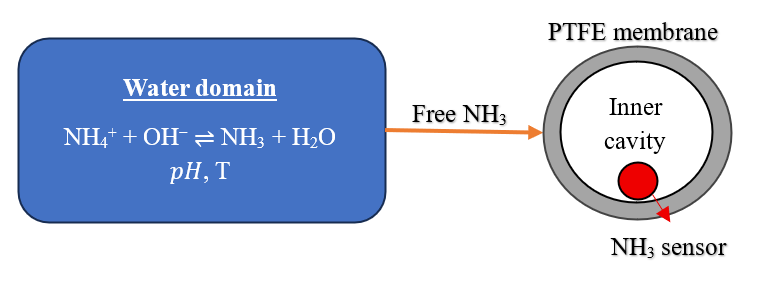
Ammonia sensing in water requires a membrane interface that enables NH3 transfer while limiting liquid intrusion into the sensor cavity. This study develops a physics-based COMSOL framework to evaluate a spherical polytetrafluoroethylene (PTFE) membrane for NH3 transfer and future gas sensor integration in water. The framework explicitly considers the water-side NH4+/NH3 equilibrium, where NH4+ is used to estimate available free NH3 but is not modeled as the transported species through the membrane. The model evaluates membrane thickness, inner diameter, pore size, active pore-area fraction, pH, temperature, NH4+ concentration, and placement depth. Results show that transfer-favorable configurations may reduce wetting resistance. Although the 22 µm pore baseline produced 6.2425 × 10⁻⁴ mol/m³ NH3 at 100 s, its wetting-safety factor was only 1.5214. The recommended design used 1.0 mm thickness, 22 mm inner diameter, 10 µm pores, and 0.75 active pore-area fraction, balancing NH3 transfer, wetting resistance, structural feasibility, and sensor-cavity compatibility.

Graphical Abstract

Polytetrafluoroethylene Membrane Design for Ammonia Transfer and Future Sensor Integration in Water
Keywords
Subjects

  • Receive Date 19 May 2026
  • Revise Date 12 June 2026
  • Accept Date 12 June 2026