Journal of Membrane Science and Research

Journal of Membrane Science and Research

Development of Multilayer Coated PES Hollow Fiber Membranes for CO2 Separation, Part 1: Preparation and Characterization

Document Type : Research Paper

Authors
1 Chemical Engineering and Pilot Plant Department, Engineering & Renewable Energy Research Institute, National Research Centre, Dokki, Giza, Postal code 12622, Egypt
2 Chemical Engineering and Pilot Plant Department, Engineering & Renewable Energy Research Institute, National Research Centre, Dokki, Giza, Postal code 12622, Egypt
3 Mechanical engineering, Engineering & Renewable Energy Research Institute, National Research Centre, Dokki, Giza, Postal code 12622, Egypt
Abstract
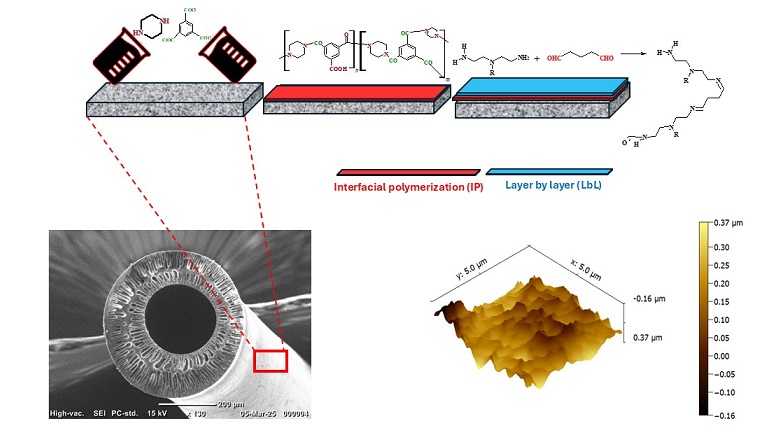
Polyether sulphone (PES) hollow fiber membranes (HFMs) have recently gained great interest for CO2 capture and utilization applications. Their preparation and surface modification play a paramount importance for achieving the appropriate characteristics for the intended application. This study investigates the effect of different modification approaches, interfacial polymerization (IP) and layer by layer (LbL) coating, on dry-wet spun PES HFMs. IP was performed using piperazine (PIP) and trimesoyl chloride (TMC) in addition to LbL using cationic polyelectrolyte polyethylenimine (PEI), and glutaraldehyde (GA) as a crosslinking agent. Single and double LbL coatings were deposited on IP initial layer. FTIR and EDS characterization confirmed successful formation of different coating layers, while SEM images showed a stable double finger-like structure with clear surface coating layers. Moreover, membrane porosity (~80%) was not sacrificed due to surface modifications. AFM results indicate increased average surface roughness for all coated samples, where IP coating exhibited the highest roughness (70.9 nm). Also, membrane hydrophilicity increased due to coating, where IP coated fibers showed the highest hydrophilicity. As for fibers mechanical properties, break stress decreased after coating, with the lowest value after IP (8.7 MPa). While LbL coating decreased the break strain by 88%, about twice the reduction observed by IP coating. Overall, combined IP and LbL techniques enhanced surface complexity, where IP introduced a selective layer and LbL coating further modified the surface characteristics, resulting in membranes with tailored properties for CO2 separation. Further improvements to LbL surface and chemical properties are recommended to optimize surface roughness and strain.

Graphical Abstract

Development of Multilayer Coated PES Hollow Fiber Membranes for CO2 Separation, Part 1: Preparation and Characterization
Keywords
Subjects

  • Receive Date 20 November 2025
  • Revise Date 08 February 2026
  • Accept Date 25 February 2026