Journal of Membrane Science and Research

Journal of Membrane Science and Research

Eco-Friendly Antifouling Membranes from Cigarette Filters Modified with Tannic Acid and Ferric Chloride for Oil Emulsion Separation

Document Type : Research Paper

Authors
1 Doctoral Program, School of Engineering Science, Universitas Syiah Kuala, Banda Aceh, Indonesia
2 Department of Chemical Engineering, Universitas Syiah Kuala, Banda Aceh, Indonesia
3 Department of Chemical and Process Engineering, Faculty of Integrated Technologies, Universiti Brunei Darussalam, Bandar Seri Begawan, Brunei Darussalam
4 Department of Chemical Science and Engineering, Kobe University, Kobe, Japan
Abstract
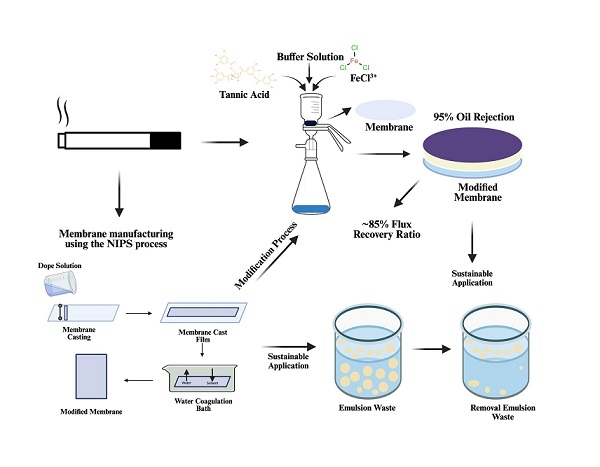
Emulsified mixtures of oil and water frequently originate from industrial, agricultural, and automotive sources, representing a major environmental concern. This study develops an eco-friendly, low-cost membrane solution using cigarette filter waste as a base material, enhanced with surface modifications using tannic acid and ferric chloride. Membranes were fabricated through the non-solvent-induced phase separation technique and modified via vacuum-assisted coating. Characterization demonstrated that the modified membrane had improved hydrophilicity, indicated by lower water contact angles and increased resistance to irreversible fouling. The surface-modified membranes demonstrated greater hydrophilicity and superior oil rejection efficiency exceeding 95% across all emulsion types and exhibited excellent antifouling properties, with flux recovery ratios of up to 85%. SEM, EDS, and FTIR analyses confirmed the formation of hydrophilic metal–polyphenol coordination layers on the membrane surface. Unlike our earlier work, which mainly reported the fabrication and preliminary performance of cigarette filter-based membranes, this study extends the investigation to multiple wastewater types (industrial, agricultural, and automotive) and introduces statistical analysis of fouling behavior to validate membrane versatility and sustainability potential. These enhancements resulted in improved separation efficiency and extended operational longevity. The bio-modified, waste-derived membrane offers a sustainable and competitive solution, emphasizing the integration of waste valorization and green surface chemistry toward advanced antifouling membrane technologies.

Graphical Abstract

Eco-Friendly Antifouling Membranes from Cigarette Filters Modified with Tannic Acid and Ferric Chloride for Oil Emulsion Separation
Keywords
Subjects

  • Receive Date 05 August 2025
  • Revise Date 14 October 2025
  • Accept Date 16 October 2025