Document Type : Research Paper
Authors
1
Doctoral Student of Agro-Industrial Technology and Engineering, Faculty of Agricultural Technology, IPB University, Bogor, Indonesia; Department of of Agricultural Technology, Ketapang State Polytechnic, Ketapang 78813, Indonesia
2
Department of Agro-Industrial Technology and Engineering, Faculty of Agricultural Technology, IPB University, Bogor 16680, Indonesia
3
Indonesian National Research and Innovation Agency (BRIN), Geostech Puspiptek Serpong, Banten Province, 15314, Indonesia
Abstract
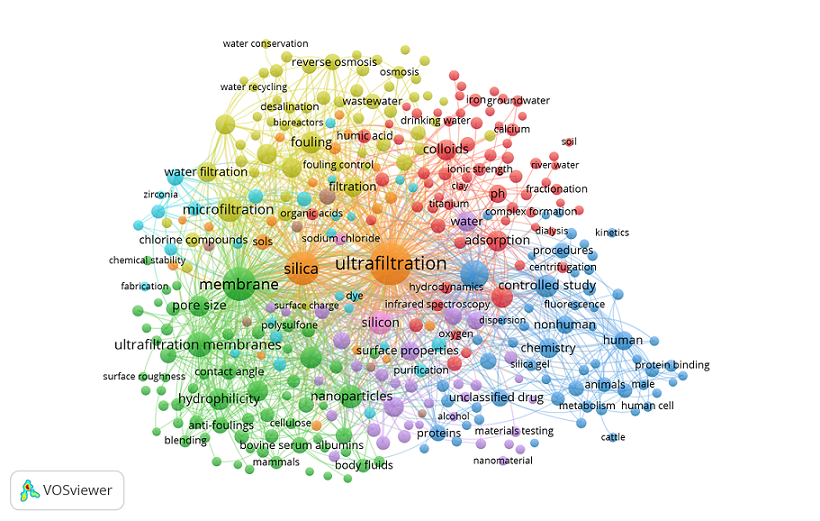
Silica-based ultrafiltration membrane research has steadily grown since 2000, with a peak in academic impact between 2008 and 2010. Although citations declined sharply during 2022–2024—dropping by 94.5% compared to the 2021 baseline (31.95 to 1.75 citations per article)—the field has sustained a compound annual growth rate of 5.88% and an average of 39.46 citations per document, underscoring its enduring academic relevance. International collaboration accounts for 21.17% of publications, reflecting strong global research engagement. China dominates in publication output with 173 articles (20.7% of the global total), while the United States demonstrates higher academic influence with 67.30 average citations per article, compared to China's 41.20. The Journal of Membrane Science leads in volume (103 articles) and impact (h-index 47; 6,603 citations), followed by Desalination and Separation and Purification Technology. Fane AG is the most influential author (h-index 13; 1,019 citations), with notable contributions from McGrath JL and Striemer CC. Research trends have evolved from traditional topics—such as fouling, adsorption, and mesoporous silica—to nanotechnology-based innovations. Recent studies highlight nanocomposite membranes, silica nanoparticles, and colloidal systems designed to enhance membrane performance and fouling resistance through surface modification and improved hydrophilicity. Future research is expected to emphasize the integration of nanomaterials with ceramic membranes and developing smart membranes for diverse applications in water treatment, pharmaceuticals, biomedicine, and chemical separation. This ongoing transition signals a shift toward more advanced and multifunctional membrane systems focused on improving durability, efficiency, and environmental sustainability.
Graphical Abstract
Keywords
Subjects