Document Type : SI: RCOM2024
Authors
1
Advanced Membrane Technology Research Center(AMTEC) University Technology Malaysia
2
Advanced Membrane Technology Research Centre, Universiti Teknologi Malaysia, 81310 UTM Johor Bahru, MALAYSIA.
3
University of Engineering and Technology Peshawar, Pakistan.
4
Institute of chemical sciences, university of Peshawar,Pakistan.
5
Advanced Membrane Technology Research Centre (AMTEC), Faculty of Chemical and Energy Engineering, Universiti Teknologi Malaysia, 81310 UTM Johor Bahru, Johor, Malaysia
Abstract
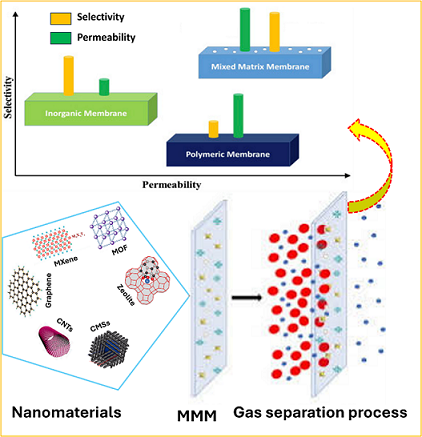
The increase in carbon dioxide (CO2) emissions is a major catalyst for climate change and global warming, intensifying the focus on developing effective CO2 capture technologies. Conventional techniques have been extensively researched and put into practice, including absorption with amine-based systems, adsorption, and cryogenic separation. However, these processes are associated with significant economic and environmental problems, such as high energy requirements and air pollution. This underlines the need for more sustainable solutions. Membrane-based CO2 capture has proven to be a viable alternative, offering advantages such as low cost, compact design, and high separation efficiency. Mixed matrix membranes (MMMs) are becoming increasingly attractive as they combine the best attributes of polymeric and inorganic membranes. As an integral part of MMMs, nanomaterials, with their large surface area, tunable pore size, and porous structure, play a crucial role in improving the performance of membranes. This review highlights recent advances, research trends, and breakthroughs in advanced nanomaterials-based MMMs. It is being investigated how various types of nanomaterials, such as MXene, graphene, metal-organic frameworks (MOFs), covalent organic frameworks (COFs), hypercrosslinked polymers (HCPs), ionic liquids (ILs), and carbon nanotubes (CNTs), influence the permeability of carbon monoxide (CO2), the selectivity of MMMs, and their thermomechanical stability. Nanoparticle agglomeration and interface adhesion issues are also addressed. Future research should focus on novel filler materials, polymer-filler compatibility, and MMM fabrication scaling for commercial applications.
Graphical Abstract
Keywords
Subjects