Document Type : SI: RCOM2024
Authors
1
Chemical Engineering Department, Engineering Faculty, Lambung Mangkurat University, Jl A. Yani Km 36, Banjarbaru 70714, South Kalimantan, Indonesia
2
Materials and Membranes Research Group (M2ReG), Banjarbaru 70714, South Kalimantan, Indonesia
3
Environmental Engineering Department, Engineering Faculty, Lambung Mangkurat University, Jl A. Yani Km 36, Banjarbaru 70714, South Kalimantan, Indonesia
4
Department of Safety Engineering, Faculty of Engineering and Industrial Technology, Institut Teknologi Kalimantan, Balikpapan, East Kalimantan, Indonesia 76127
5
Environmental Science Doctoral Program, Lambung Mangkurat University, Banjarmasin, South Kalimantan, Indonesia 70123
6
Advanced Membrane Technology Research Centre (AMTEC), School of Chemical and Energy Engineering, Universiti Teknologi Malaysia, Johor Bahru 81310, Malaysia
Abstract
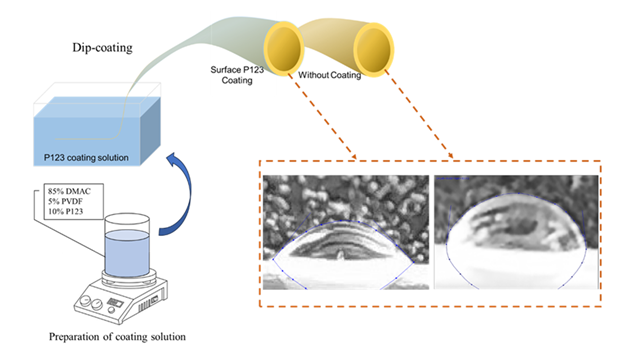
Polyvinylidene fluoride (PVDF)-based polymer membranes are widely used in various applications due to their desirable properties, i.e., thermal stability, high mechanical strength, and favourable processing characteristics. However, the inherent hydrophobicity of PVDF limits its performance in aqueous environments because it can lead to fouling. In this work, Pluronic P123 is employed to modifying the properties of PVDF hollow fiber membranes as a coating agent to enhance the membrane hydrophilicity. The hollow fiber PVDF membrane is prepared through wet spinning method with various additives, such as Titanium dioxide and polyethylene glycol. Subsequently, the membrane was coated with a Pluronic P123 solution and characterized by using Fourier Transform Infrared (FTIR) spectroscopy, Scanning Electronic Microscopy (SEM), porosity measurements, and water contact angle analysis. The hollow fiber membrane that was obtained was coated and exhibited a sandwich structure morphology with a rougher and porous surface. The FTIR spectra revealed a dominant β-phase crystalline structure in the PVDF-TiO2-PEG/P123 composite, with the largest peak area reaching 3.21. The membrane exhibited high porosity and a reduced water contact angle of 48° with the highest value reaching 6.55 Kg.m2.h-1.
Graphical Abstract
Keywords
Subjects