Document Type : SI: RCOM2024
Authors
1
Materials and Membranes Research Group (M2ReG), Banjarbaru 70714, South Kalimantan, Indonesia
2
Departement of Chemical Engineering, Engineering Faculty, Lambung Mangkurat University, Jl A. Yani Km 36, Banjarbaru 70714, South Kalimantan, Indonesia
3
Department of Safety Engineering, Faculty of Engineering and Industrial Technology, Institut Teknologi Kalimantan, Balikpapan, East Kalimantan, Indonesia 76127
4
Environmental Science Doctoral Program, Lambung Mangkurat University, Banjarmasin, South Kalimantan, Indonesia 70123
Abstract
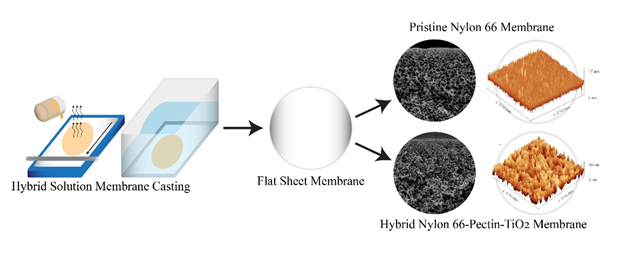
Polymer membranes face several challenges, including fouling, limited lifespan, stability concerns, and suboptimal selectivity. Hybrid modification, which incorporates organic and inorganic materials into the membrane matrix, is a promising strategy to address these limitations. This study investigates surface morphology (SEM, roughness and porosity) properties of nylon 66 polymer membranes were modified via the phase inversion technique by adding pectin (organic) and titanium dioxide (TiO2) (inorganic) as additives. The morphological structure, surface roughness, average pore size, and porosity of the membranes were characterized using scanning electron microscopy (SEM) and analyzed with Gwyddion and ImageJ software. The pure water flux was evaluated through ultrafiltration tests. The hybrid membrane demonstrated smaller pore sizes and a surface roughness approximately three times greater than that of the pristine nylon 66 membrane. The average pore sizes were approximately 0.2 μm for the hybrid membrane and 0.4 μm for the pristine nylon 66 membrane. The porosity of the pristine nylon 66 membrane was around 60%, whereas the nylon 66-pectin-TiO2 composite membrane had a porosity of approximately 50%. The structural modifications had a considerable impact on the membrane performance, with the hybrid membrane demonstrating a stable flux compared to the unmodified membrane. It was concluded the incorporation of TiO2 and pectin enhances the structural integrity and stability of the membrane, presenting a promising pathway for further advancements in polymer membrane technology.
Graphical Abstract
Keywords
Subjects