Journal of Membrane Science and Research

Journal of Membrane Science and Research

Mathematical Modeling of Direct Contact Membrane Distillation (DCMD) Using Knudsen-Diffusion Model for PVDF Membranes

Document Type : Research Paper

Authors
1 Chemical Engineering Department, Amirkabir University of Technology, Tehran 15875-4413, Iran
2 Department of Chemical Engineering and Applied Chemistry, The University of Toronto, 200 College Street, Toronto ON, Canada, M5T 3E5
Abstract
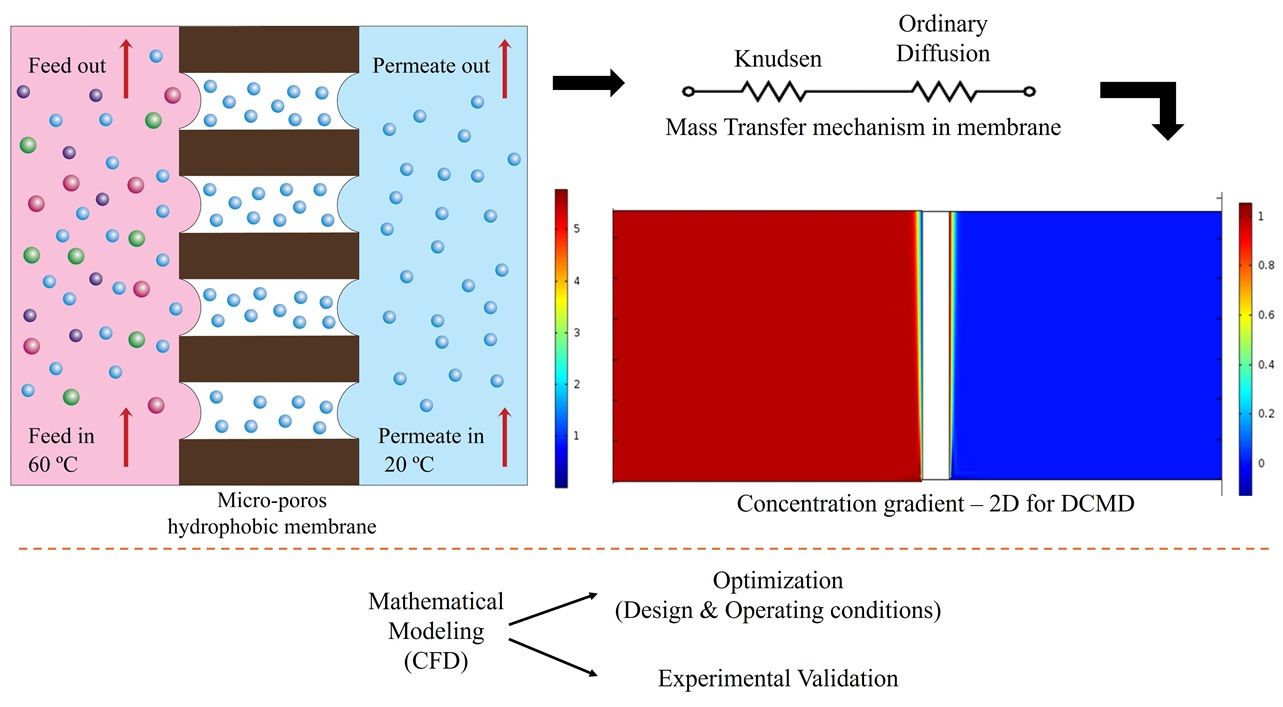
A large number of people around the world are experiencing water shortages today. Researchers and industries have searched for novel desalination methods containing high purification and efficiency to decrease the costs associated with desalination processes. In particular, membrane distillation (MD) has received considerable attention owing to the optimum conditions. During direct contact membrane distillation (DCMD), on the hot feed side, saline water evaporates, crosses the porous, hydrophobic membrane, and finally condenses on the cold permeate side. CFD modeling utilizing the Finite Element Method (FEM) is used in this study to determine optimized parameters, i.e., design and operating conditions. The Knudsen diffusion, combined with Molecular diffusion is applied to predict the diffusion followed by Raoult’s law considering, which are lacking and require to be addressed. Furthermore, it is validated by experimental results on PVDF membranes, resulting in an acceptable agreement between the experimental and modeling results. It is observed that by increasing 30% of membrane porosity, 9% of feed temperature, and 800% of feed velocity, membrane flux increases by 76%, 445%, and 11%, respectively. However, if there is an increase of 16% of membrane thickness and 10% of permeate temperature, the membrane flux is reduced by 12.7% and 225%, respectively.

Graphical Abstract

Mathematical Modeling of Direct Contact Membrane Distillation (DCMD) Using Knudsen-Diffusion Model for PVDF Membranes
Keywords
Subjects

  • Receive Date 10 September 2024
  • Revise Date 04 February 2025
  • Accept Date 10 February 2025