Document Type : Review Paper
Authors
1
Chemical Engineering, College of Engineering and Technology, University of Technology and Applied Sciences-Salalah, Salalah, Sultanate of Oman
2
Department of Chemical Engineering, School of Studies of Engineering and Technology, Guru Ghasidas Vishwavidyalaya (A Central University), Koni, Bilaspur, Chhattisgarh-495009. India.
3
Department of Chemical and Petroleum Engineering, School of Engineering & Computing, American University of Ras Al Khaimah (AURAK), Ras al Khaimah, United Arab Emirates
4
Mechanical and Mechatronic Engineering, Faculty of Engineering, Sohar University, Sohar, Sultanate of Oman
5
Mechanical and Industrial Engineering section, Mechanical Engineering specialization,, College of Engineering and Technology, University of Technology and Applied Sciences, Muscat, Sultanate of Oman
6
Department of Petroleum Technology, Aditya University, Surampalem, Andhra Pradesh, India
7
Department of Chemical Engineering, RVR & JC College of Engineering, Chowdavaram, Guntur, AP-522019, India
Abstract
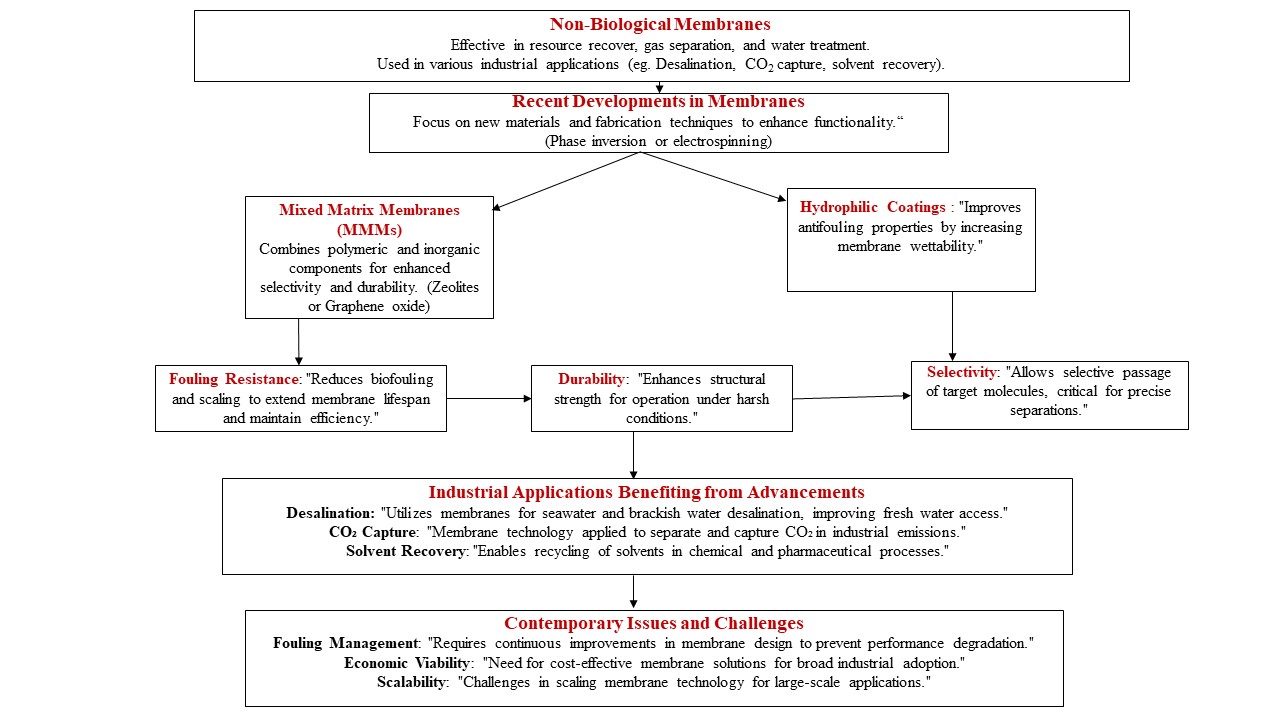
Non-biological membranes are essential in several sectors, providing outstanding performance in key applications like resource recovery, gas separation, and water treatment. Recent developments in nanocomposite membranes are highlighted in this study, with an emphasis on new materials and improved fabrication processes that increase fouling resistance, durability, and selectivity. Important advancements as mixed matrix membranes and hydrophilic coatings have greatly improved functional optimization, allowing these membranes to perform well under challenging circumstances. These developments improve efficiency and sustainability in particular industrial applications including desalination, CO₂ capture, and solvent recovery. This study also discusses contemporary issues like fouling management, economic viability, and scalability, highlighting the necessity of continued research in hybrid membrane designs and environmentally acceptable materials. These developments show how crucial non-biological membranes are becoming to finding sustainable solutions across a range of industries, necessitating ongoing research to increase their potential and meet demands for environmental preservation and resource management around the world.
Graphical Abstract
Keywords
Subjects