Journal of Membrane Science and Research

Journal of Membrane Science and Research

Tailoring the C3H6/C3H8 Separation Performance with PEG-Modified Polyetherimide (PEI) Membranes

Document Type : Research Paper

Authors
EOR and Gas Processing Research Lab, Faculty of Chemical Engineering, Babol Noshirvani University of Technology, Babol, Iran
Abstract
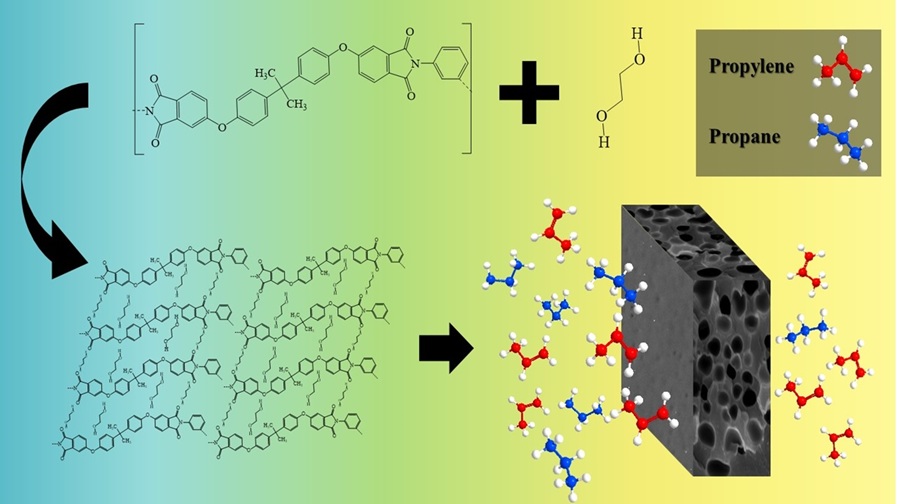
Separating propylene (C3H6) from propane (C3H8) is a significant challenge due to the same carbon numbers and similar physical properties. Nowadays, among the various methods for C3H6/C3H8 separation, membrane processes are gaining significant interest. The inherent selectivity of the polyetherimide (PEI) as a glassy polymer and the plasticizing effect of the polyethylene glycol (PEG) as a rubbery polymer combine in this study, resulting in improved C3H6 permeability and, consequently, C3H6/C3H8 selectivity. The gas permeability test of the pure and blended membranes, which contain varying PEG weight percentages, conducted at pressure of 2 bar and a temperature of 30ºC, shows enhanced gas separation performance. The permeability of C3H6 increased significantly. It rose from 3.86 Barrer in the pure PEI to 13.87 Barrer in the PEI/PEG 20 wt.% blend membrane, showing a 260% improvement. Additionally, the C3H6/C3H8 selectivity also rises from 4.76 to 8.72 in the PEI/PEG 20 wt.% blend membrane, indicating an 83% improvement. By increasing the pressure up to 10 bar, plasticization does not occur in either the pure membrane and or the blended membranes with up to 20 wt.% PEG; However, plasticization occurs in the blended membrane with 30 wt.% PEG at a pressure of 6 bar.

Graphical Abstract

Tailoring the C3H6/C3H8 Separation Performance with PEG-Modified Polyetherimide (PEI) Membranes
Keywords
Subjects

  • Receive Date 04 December 2024
  • Revise Date 11 January 2025
  • Accept Date 17 January 2025