Journal of Membrane Science and Research

Journal of Membrane Science and Research

Ceramic Membrane Contactors for Liquid-Liquid Extraction: Experimental and Modeling Aspects

Document Type : Research Paper

Authors
1 CEA, DEN, F-30207 Bagnols-sur-Cèze, France
2 Aix Marseille Univ, Centrale Marseille, M2P2 UMR 7340, Equipe Procédés Membranaires (EPM), Europôle de l’Arbois, BP80, Pavillon Laennec, Hall C, 13545 Aix en Provence Cedex, France
3 Aix Marseille Univ, CNRS, MADIREL UMR 7246, Campus St Jérôme 13397 Marseille Cedex 20, France
4 SIVA, Z.A. Les Laurons – CS 65 – 2611 Nyons Cedex, France
5 TAMI Industries, Z.A. Les Laurons – CS 65 – 2611 Nyons Cedex, France
Abstract
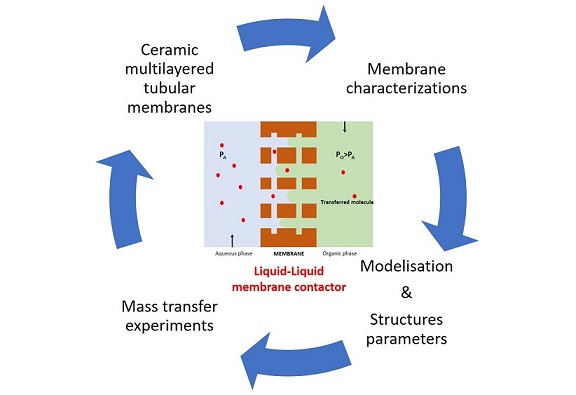
Pertraction is a fluid-fluid extraction process where a solid porous membrane separates two liquids phases but allows their contact inside its porous structure. This process is used here to transfer nitric acid from an aqueous solution to an organic one by using hollow fiber membranes made of ceramic that ensures a high chemical stability. In order to model the process and to predict the functioning conditions, a number of characterization methods are used to determine the material structure parameters and liquid properties parameters that will be then introduced in a mass transfer model. Contact angle, tortuosity, porosity, diffusion coefficients are thus determined by methods specially adapted to this membrane configuration such as capillary rise, liquid-liquid displacement, impedancemetry, diffusion experiments, mercury porosimetry. These membranes are composed of three layers, support, coating and active layer with pore sizes in the range 4 µm, 0.5 µm and 30-200 nm, respectively. After characterization, these membranes are tested for the transfer of nitric acid from an aqueous solution to an organic phase made of a tributylphosphate / dodecane mixture. An in-series model using material structure parameters and diffusion coefficients is developed. It shows a reasonable agreement between measured and calculated transferred flux of nitric acid. It also suggests that, in the studied cases, the liquid-liquid interface is generally situated inside the support layer.

Graphical Abstract

Ceramic Membrane Contactors for Liquid-Liquid Extraction: Experimental and Modeling Aspects
Keywords
Subjects

  • Receive Date 12 March 2024
  • Revise Date 23 December 2024
  • Accept Date 30 December 2024