Document Type : Research Paper
Authors
1
Department of Chemical Engineering, Faculty of Engineering, Universitas Jember, Jalan Kalimantan 37, Jember, 68121, Indonesia
2
Research Center for Materials Science, Energy Efficiency, and Waste Water Management, Universitas Jember, Jalan Kalimantan 37, Jember, 68121, Indonesia
3
Department of Chemistry, Faculty of Science and Data Analytics, Institut Teknologi Sepuluh Nopember, Kampus ITS Sukolilo, Surabaya, 60111, Indonesia
4
Department of Chemical Engineering, Faculty of Engineering, Universitas Pembangunan Nasional “Veteran” Jawa Timur, Surabaya, East Java, 60294, Indonesia
5
Low Carbon Technologies Research Center, Universitas Pembangunan Nasional “Veteran” Jawa Timur, Surabaya, East Java, 60294, Indonesia
Abstract
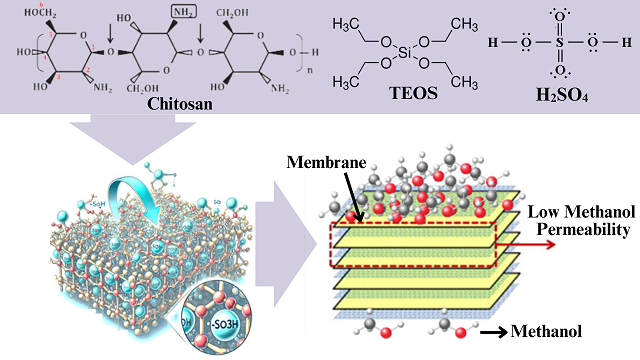
This research examines the development and evaluation of sulfonated chitosan-TEOS composite membranes for prospective application in direct methanol fuel cells (DMFCs). We enhanced the characteristics of chitosan derived from shrimp shells by using tetraethyl orthosilicate (TEOS) and sulfuric acid. We employed Fourier-transform infrared (FTIR) spectroscopy to identify the chemical constituents of the membranes. Subsequently, we assessed their water contact angle (WCA), thermogravimetric analysis (TGA), and electrochemical impedance spectroscopy (EIS) to determine their hydrophilicity, thermal resistance, and electrochemical activity. The results demonstrated that membrane B had the lowest water contact angle, indicating superior hydrophilicity and proton conductivity. The TGA results indicated the membrane thermal stability, exhibiting significant weight retention up to 500 °C, affirming their heat resistance. We assessed the membranes' selectivity, revealing an ideal equilibrium between elevated proton conductivity and diminished methanol permeability. The results indicate that sulfonated chitosan-TEOS composite membranes are promising for DMFCs applications. This underscores the opportunity to modify their composition to enhance performance in sustainable energy solutions.
Graphical Abstract
Keywords
Subjects